Since 2020, Diane has been developing a creative practice in solidarity with Rice’s whales, who, despite only recently being recognized as a distinct species by Western science, have existed in the Gulf of Mexico for millions of years. This ongoing research connects their stories to broader environmental justice movements, communicating how significantly these whales are threatened by the sounds of oil exploration that monopolize the Gulf’s acoustic space.
The Whale’s Gulf is a term developed collectively in 2025 by artist collective Whale Liberation Front (Imani Jacqueline Brown, Peter Johnson Bowling, and Cory Diane) as a reframing of the body of water known by many of us as the Gulf of Mexico.
Eden’s Garden
2026 · Performance
Cory Diane and Peter J. Bowling · Zither, saxophone, voice, Auto-Tune, computer, live multichannel electronics, and whale field recordings · Institute of the Arts and Sciences, UC Santa Cruz
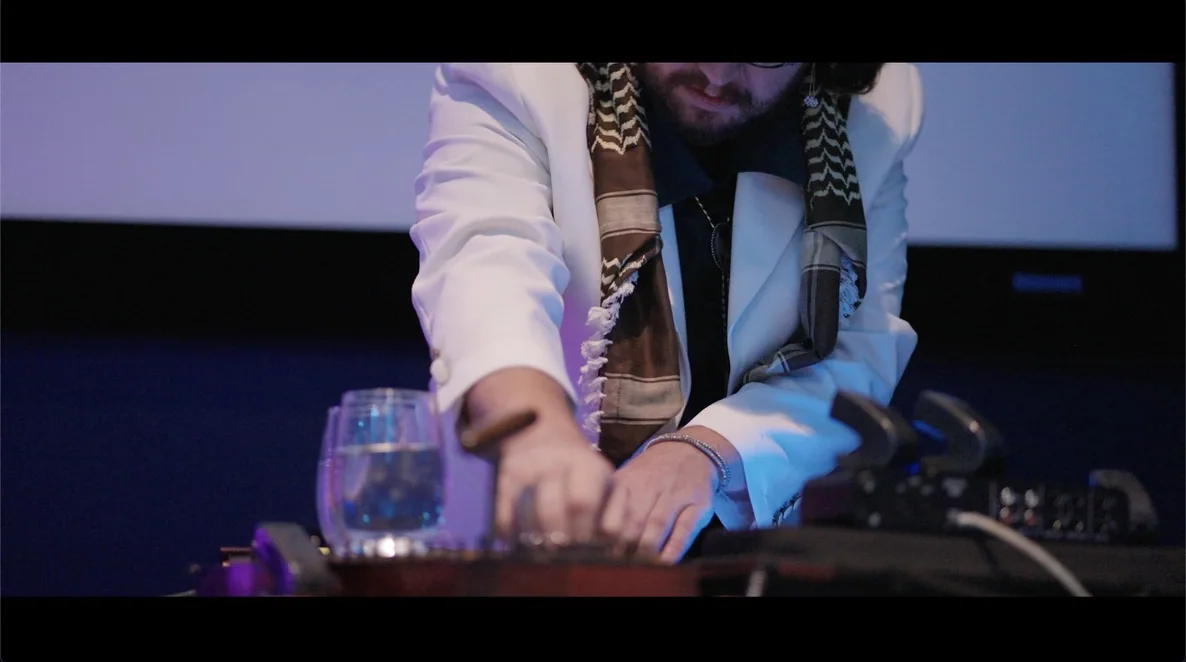
Eden’s Garden — performance excerpt · Open video ↗
Eden’s Garden is a collaborative performance connecting Rice’s whales of the Gulf of Mexico with their closest evolutionary relatives, including Eden’s whales and the Bryde’s whales of the Gulf of California. Though their lineages diverged millions of years ago, they remain linked through an ancient evolutionary history across the world’s oceans.
Through zither, saxophone, voice, live multichannel electronics, and field recordings of these whales, Cory Diane and Peter J. Bowling explore these ancient relationships across two bodies of water. The performance also explores Auto-Tune’s origins in seismic signal processing for oil exploration.
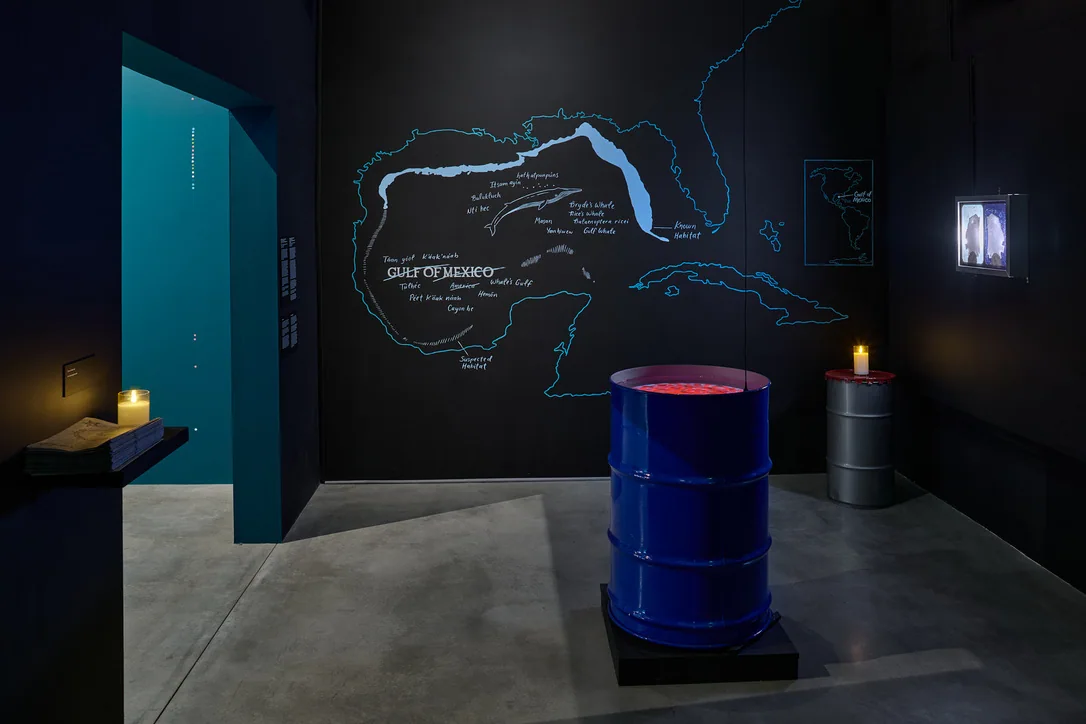
Untitled, or, they’ve been singing since the gulf was born
2025 · Installation
Whale Liberation Front (Imani Jacqueline Brown, Peter J. Bowling, Cory Diane). Single-channel video, 8.1-channel reactive audio, hydrophone, crude oil drum, metal, water. Commissioned for Weather and the Whale, Institute of the Arts and Sciences, UC Santa Cruz.
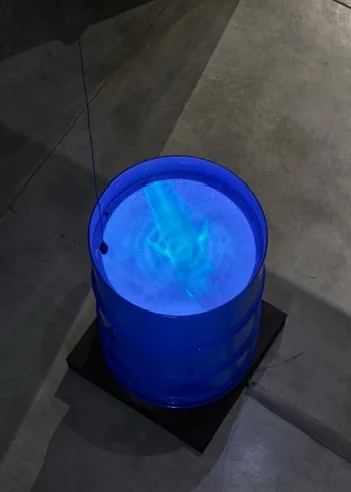
Installation view, UC Santa Cruz. Photography: IAS, UC Santa Cruz.Overhead installation view · Photography: Institute of the Arts and Sciences (IAS), UC Santa Cruz.
Photography: Institute of the Arts and Sciences (IAS), UC Santa Cruz.
Whale Liberation Front — IAS artist interview · Open video ↗
An immersive soundscape and video installation honoring the long presence of whales in the Gulf of Mexico, or Whale’s Gulf, while exploring how the whales may acoustically experience the heavy presence of oil and gas exploration and production.
A subwoofer inside a hollowed crude oil drum blasts the sound of a seismic airgun, the tool extractive industries use to map the seafloor. The drum’s base, hammered into a concave basin like a steel pan, holds water that ripples with each blast. A hydrophone suspended in the water receives the signal, and this violent sound is reclaimed and processed live through an 8-channel circular sound composition. Projected onto the water: footage of the Gulf whale from a September 2024 survey, aerial photography of the 2010 Deepwater Horizon spill, and animated GIS maps of oil and gas infrastructure in the whale’s gulf.
Reverie for the Baleen of the Gulf of Mexico of Many and No Known Names, Vol. 2
2023 · Zither, banjo, voice, and live 8-channel electronics
Performed by Peter J. Bowling, Cory Diane, Michaela Harrison, and Clementine Hartman.
Video still: KT Bryden.
Commissioned by the Smithsonian National Museum of Natural History for Whales on the Brink, the first national symposium on Rice’s whales, commemorating the 50th anniversary of the Endangered Species Act.
When the Smithsonian wasn’t able to provide a grand piano, I decided to develop a new piece for banjo and zither, extending the same ethic of instrumental exploration that guided Reverie, Vol. 1, while opening up an opportunity to collaborate with Michaela Harrison, an extraordinary vocalist and the creator of Whale Whispering.
Reverie for the Baleen of the Gulf of Mexico of Many and No Known Names, Vol. 1
2022 · Grand piano, 3–5 performers, and live 8-channel electronics
Developed in collaboration with performers Peter J. Bowling, Clementine Hartman, Denise Frazier, and Renee Anderson. Performed at New Music on the Bayou and the New Orleans Center for the Gulf South.
Reverie for the Baleen of the Gulf of Mexico of Many and No Known Names, Vol. 1 is a research, composition, and performance practice developed in relation and solidarity with Rice’s whales and the acoustic life of the Gulf of Mexico.
We play the whole body of the grand piano—inside and out, top to bottom. Using breath, bow hair, electromagnets, friction mallets, paper, and other materials, we coax the vocalizations of whales from the instrument alongside the sounds of industrial activity that monopolize their acoustic space. These sounds intermingle with underwater recordings of Rice’s whales through an eight-channel surround-sound system.
The work explores the possibilities of listening and sounding across species, bringing the resonances of a familiar instrument into relationship with the acoustic life of the Gulf.